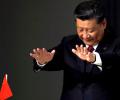
Chinese President Xi Jinping on Tuesday visited an exhibition of the Communist Party, appearing in public for the first time after his return from the SCO summit on September 16, which sparked rumours about his absence from the limelight ahead of next month's key Congress of the ruling party.

'If China shows greater concerns for Indian interests, ties could improve. Otherwise, the thaw could be short-lived.'
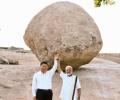
'My understanding is that by the time President Xi Jinping came for the Chennai summit [2019], he had already instructed his army to undertake the action in Galwan in the summer of 2020.'

Modi arrived by a special flight from Delhi and was received by Tamil Nadu Governor Banwarilal Purohit and Chief Minister K Palaniswami among others.

Chinese President Xi Jinping is all set for an unprecedented third five-year term as he was 'elected' to the powerful Central Committee of the ruling Communist Party on Saturday while several top leaders including Premier Li Keqiang have been left out in the major shake-up at the top.
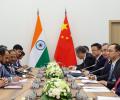
According to informed sources, Doval will arrive in Beijing on Tuesday to attend the crucial talks, which were expected to provide a way forward for the two countries to normalise the relations.
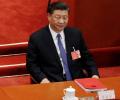
Xi made the remarks in a verbal message to Pakistani President Arif Alvi, state-run Xinhua news agency reported.

Chinese President Xi Jinping and Canadian Prime Minister Justin Trudeau had a heated exchange of words on the sidelines of the G20 summit in Bali on Wednesday, with the Chinese leader complaining about the media reporting about their communication, according to a video of the meeting posted by a Canada-based journalist.
Chinese President Xi Jinping on Wednesday pledged to strengthen the strategic relationships with neighbouring countries by 'appropriately' managing differences and enhancing supply chain ties as China's tariff war with the United States escalated.
China welcomes Prime Minister Narendra Modi's planned visit to the Tianjin Summit of the Shanghai Cooperation Organisation (SCO), expressing hope that the event will be a 'gathering of solidarity, friendship and fruitful results'.
'What's currently underway is not a 'reset'.' 'What needs to be arrived at is a new balance.'

According to sources, India would be invited to the new proposed forum, while countries like Sri Lanka, Maldives, and Afghanistan are expected to be part of the grouping.

China appears determined to upgrade Pakistan's military capabilities, sufficient to ensure local parity with India, alerts former foreign secretary Ambassador Shyam Saran.

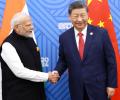
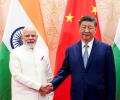
Prime Minister Narendra Modi and Chinese President Xi Jinping shook hands on Tuesday at a side event at the G20 Summit in Bali, a gesture drawing some attention because of the strained relations between the two countries over a border clash two years back.
As United States President Joe Biden prepares for a rare summit with Chinese President Xi Jinping, the ongoing wars in Ukraine and between Israel and Hamas set the stage for high-stakes discussions, CNN reported on Tuesday.
Chinese President Xi Jinping on Tuesday issued a new mobilisation order for the training of armed forces with a focus on developing an elite force capable of fighting and winning wars.

India and China have reached new common understandings agreeing to conduct normalised management and control of the boundary during Foreign Minister Wang Yi's visit to New Delhi, Beijing said.
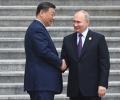
"The two sides note that the relationship between Russia and China has progressed to a more advanced interstate cooperation compared to the military-political unions of the Cold War era as it is not bloc or confrontational in nature, nor does it target any third countries," Russia's new agency Tass quoted the document as saying.

Speaking at his closing press conference at the COP26 Summit, Biden expressed disappointment over with Chinese actions on climate in Rome, and also the lack of willingness for Chinese President Xi Jinping to show up at either the G20 or COP26 summit.

New Delhi 'will have to take a call which supply source suits us the best,' the finance minister said, pointing out that crude oil accounts for the bulk of India's foreign exchange spend.
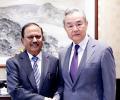
Wang is travelling to India days ahead of Prime Minister Narendra Modi's planned trip to the Chinese city of Tianjin to attend the annual summit of the Shanghai Cooperation Organisation.

The statement by John Kirby, national security council coordinator for strategic communications at the White House, came as Putin hosted the Chinese leader.

'We will likely never know why Xi decided not to travel to New Delhi. One possible explanation could be his desire to avoid a meeting with US President Joe Biden.'

Xi commended the battalion members for their remarkable efforts in guarding China's border region, noting that they have dedicated their youth to securing the country's territorial integrity and have accomplished their missions well, state-run Xinhua news agency reported.

Taking Kharg would give the US control over virtually all of Iran's oil exports and thus provide significant leverage, notes Prem Panicker in his must read daily blog on the Gulf War. It would also put American troops within range of Iran's remaining missiles, drones, and artillery on a piece of real estate that is just eight square miles in size, and just 15 miles from the Iranian mainland.

At 15, 'princeling' Xi Jinping was forced to quit luxuries of city life and sent to work in the villages and mountains. Come March 2013, he will be the leader of over 1.3 billion Chinese people. We present the story of China's president-in-waiting.

Rediff reader Chandru U from Chennai sent us these stunning pictures of Mahabalipuram's Shore Temple.

China has made serious inroads into Latin America, which the US may now be hinting is simply not ok: Stay in your lane, Xi! In simple terms, China will no longer have access to Venezuelan oil, points out Rajeev Srinivasan.

India and China reviewed the situation along the Line of Actual Control (LAC) in eastern Ladakh and prepared for the next Special Representatives' dialogue on the boundary question.
The last time he left his country was a month after the coronavirus appeared in a market in the Chinese town of Wuhan in December 2019.
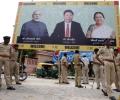
Gujarat has put up posters to welcome the Chinese President Xi Jinping

Chinese President Xi Jinping, who made a rare visit this week to the restive Xinjiang region which borders Ladakh, met the troops and officers stationed there and praised their "outstanding contributions" to the border defence and stabilisation of the volatile province.
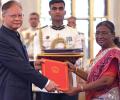
Praising the Indian students awarded at the function, he said the young generation is the hope of the two countries.
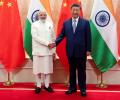
'China's basic purpose of taking the Shaksgam Valley was access to the Indian Ocean.'

The formulations in the declaration in reference to terrorism is going to be to our "satisfaction", Dammu Ravi, secretary (economic relations) in the external affairs ministry said on Monday.

Ukrainian President Volodymyr Zelenskyy has backed the imposition of tariffs on countries maintaining economic ties with Russia, saying it is the 'right idea' in the face of continued aggression by Moscow.
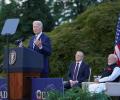
United States President Joe Biden was caught on a hot mic telling leaders of the Quad nations that China was testing them, thus reflecting upon the American seriousness of the emerging Chinese threat.
China firmly opposes the Trump administration's 50 percent tariffs on India as it is "unfair and unreasonable" and New Delhi and Beijing should scale up economic ties to jointly counter the challenge, Chinese ambassador Xu Feihong said on Monday.

National Security Advisor Ajit Doval stated that India-China relations have shown an "upward trend" in the past nine months, with peace prevailing along the Line of Actual Control (LAC). This statement was made during talks with Chinese Foreign Minister Wang Yi on the boundary issue, ahead of Prime Minister Modi's visit to China for the SCO summit.
Chinese Foreign Minister Wang Yi said on Friday that India-China relations have made positive strides and achieved a series of encouraging outcomes at all levels after last year's breakthrough ending the over four-year-long military standoff in eastern Ladakh. Wang's remarks came during his annual press conference as he replied to a question on how Beijing views the course of bilateral ties after the two countries ended the prolonged stalemate in the ties.
